
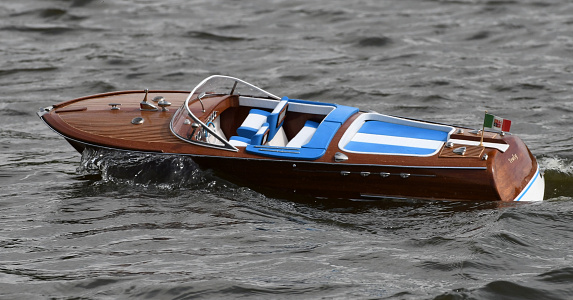
After weeks of waiting for the kit to be delivered from Italy I re-ordered instead from Cornwall Model Boats and received it next day. The box was smaller than the one for my Riva but at a quick glance all the parts seem to be there. Now that I have received the kit for this motor sailor I can start to plan how to attach a detachable keel and a detachable extension to the rudder. There is an optional motorisation pack available which uses one motor but drives two props through a gear system. Myself and Roycv are thinking of using 2 separate motors but I'll check space available. Not sure whether with potentially 3 sails we can get away with one winch because it looks like space is at a premium. I must say the Amati Italian Runabout kit had very much clearer build instructions than this kit with lots of photos of various stages. Before I can start building this I need to resolve a problem with my newly fitted fireboat's fire monitors! Hopefully my blog will help to fill in missing information. It might be a slow build log because I'm limited with pains in my hands how much I can do at a time - so to those followers please be patient!😊 Some photos of the box content:-
[{"id":"168787536826","name":"168787536826","caption":"","url":"https:\/\/model-boats.com\/media\/168787536826\/l","thumbUrl":"https:\/\/model-boats.com\/media\/168787536826\/s","isImage":false,"ext":"file"},{"id":"168787538623","name":"168787538623","caption":"","url":"https:\/\/model-boats.com\/media\/168787538623\/l","thumbUrl":"https:\/\/model-boats.com\/media\/168787538623\/s","isImage":false,"ext":"file"},{"id":"168787540454","name":"168787540454","caption":"","url":"https:\/\/model-boats.com\/media\/168787540454\/l","thumbUrl":"https:\/\/model-boats.com\/media\/168787540454\/s","isImage":false,"ext":"file"},{"id":"168787541559","name":"168787541559","caption":"","url":"https:\/\/model-boats.com\/media\/168787541559\/l","thumbUrl":"https:\/\/model-boats.com\/media\/168787541559\/s","isImage":false,"ext":"file"}]
After weeks of waiting for the kit to be delivered from Italy I re-ordered instead from Cornwall Model Boats and received it next day. The box was smaller than the one for my Riva but at a quick glance all the parts seem to be there. Now that I have received the kit for this motor sailor I can start to plan how to attach a detachable keel and a detachable extension to the rudder. There is an optional motorisation pack available which uses one motor but drives two props through a gear system. Myself and Roycv are thinking of using 2 separate motors but I'll check space available. Not sure whether with potentially 3 sails we can get away with one winch because it looks like space is at a premium. I must say the Amati Italian Runabout kit had very much clearer build instructions than this kit with lots of photos of various stages. Before I can start building this I need to resolve a problem with my newly fitted fireboat's fire monitors! Hopefully my blog will help to fill in missing information. It might be a slow build log because I'm limited with pains in my hands how much I can do at a time - so to those followers please be patient!😊 Some photos of the box content:-
H i Duncan all good stuff you have ordered and will all fit together.
If you want more advice I do need to know how many channels your radio has.
The 2 esc's will plug into the mixer and that will give you a single control on the transmitter for both of the motors to run.
Check which o/p is which. So left rudder slows down the port motor. You can share the power battery with the 2 esc's. Remember to cut one red wire in one of the esc's servo leads.
The single line from the mixer goes into the signal wire in the socket end of one Y lead tail and the rudder servo lead goes in the other, then the Y lead goes into the rudder socket on the receiver.
You can do all this with a standard 4 channel RC set. Left hand up/down to throttle. Right hand up/down to winch, remember to set it so that when tx. stick is fully away from you the sails are out. Right hand left/right is the rudder.
I should not complicate it further. There is no diagram needed.
Relax and enjoy the build.
I am just making a second sail set, this will give me 2 options, on my Gracia and it does not matter how high or low I put the yacht my back still aches! If it all works I will photograph the yacht and put it into My Harbour.
Roy
Finally my hands weren't aching today so I've made a start on the Mantua Bruma. I've punched out all the frame parts and filed the laser burns off the joints. I then dry assembled the pieces and now I have an idea of the hull shape. Originally I thought I would glue all the frames in place and then fit the 6 reinforcement frames afterwards and these are located just below the deck. Having found lining up the frames and the reinforcements was a bit tricky I have decided because the Aliphatic glue goes off reasonably quickly I will assemble it in 3 stages doing the ribs and the corresponding reinforcements in the same group stage.
The mounting base for the motor is specific for the optional motor and gear system. This uses one motor to drive both propellers. I was informed that this was very noisy so I've opted for two motors with each driving a propeller. Therefore some modification will be required! Time to start to ponder the mounting! Has anyone done this before with a Bruma kit please?😊 I will sand the burns from the rest of the frames and also feather the front and back frames to accept the planks with a better area of contact.
[{"id":"169238844219","name":"169238844219","caption":"","url":"https:\/\/model-boats.com\/media\/169238844219\/l","thumbUrl":"https:\/\/model-boats.com\/media\/169238844219\/s","isImage":false,"ext":"file"},{"id":"169238844281","name":"169238844281","caption":"","url":"https:\/\/model-boats.com\/media\/169238844281\/l","thumbUrl":"https:\/\/model-boats.com\/media\/169238844281\/s","isImage":false,"ext":"file"}]
Finally my hands weren't aching today so I've made a start on the Mantua Bruma. I've punched out all the frame parts and filed the laser burns off the joints. I then dry assembled the pieces and now I have an idea of the hull shape. Originally I thought I would glue all the frames in place and then fit the 6 reinforcement frames afterwards and these are located just below the deck. Having found lining up the frames and the reinforcements was a bit tricky I have decided because the Aliphatic glue goes off reasonably quickly I will assemble it in 3 stages doing the ribs and the corresponding reinforcements in the same group stage.
The mounting base for the motor is specific for the optional motor and gear system. This uses one motor to drive both propellers. I was informed that this was very noisy so I've opted for two motors with each driving a propeller. Therefore some modification will be required! Time to start to ponder the mounting! Has anyone done this before with a Bruma kit please?😊 I will sand the burns from the rest of the frames and also feather the front and back frames to accept the planks with a better area of contact.
Hiya. I intend to use the motors with 7.2v battery. I have a piece of 8 core ply that is exactly 3.5" wide x 13" x 7/16" which I thought will be ideal to shape for the keel. I'll just shorten it! Fitting the securing rods sounds as though it will be a challenge so they don't turn when tightening the nuts. I will have to think about how to follow your method. Thanks for your help and advice. 😊
Following Roy's suggested design, I've now created the fixings for a removeable keel. This consists of two stainless steel tubes fitted into the keel which will accept two 3mm diameter S/S machined rods which are attached to the removeable keel. The rods are secured into the removeable keel with two collets which have been sunk into the thickness of the keel. Roy suggested that I should make sure the rods don't turn when when tightening the nuts in the hull. To this end I have fitted 2x 3mm bolts into the collets rather than using the supplied grub screws (see photo). These are longer than the depth of the bolt hole and therefore stand out from the collet which creates a 'stop' as I didn't drill completely through the wood. The holes were then filled with Araldite glue. I was advised by a club member not to use the Rapid Araldite as apparently it goes soft in water so I used the slow setting original type. Again following Roy's suggestion, I glued one of the 3mm ply backing pieces into place which will cover the cuts in the keel for the tubes and let it go hard. This then preserves the shape and dimensions of the keel. I then cut the two slots for the 2 keel tubes, spot glued the tubes in place with CA whilst the removeable keel was in place. I then used the epoxy glue to cement the 83mm x 4.8mm tubes in place and added the other 3mm ply to the other side of the keel and clamped them up very tightly over 24hrs. Now that the method of fixing the keel has been sorted I can now carry on with the rest of the 'normal' kit build! 😊 Last photo shows dry assembly of the frames with frames at the bow and stern with chamfered edges.
[{"id":"169503817887","name":"169503817887","caption":"","url":"https:\/\/model-boats.com\/media\/169503817887\/l","thumbUrl":"https:\/\/model-boats.com\/media\/169503817887\/s","isImage":false,"ext":"file"},{"id":"169503825912","name":"169503825912","caption":"","url":"https:\/\/model-boats.com\/media\/169503825912\/l","thumbUrl":"https:\/\/model-boats.com\/media\/169503825912\/s","isImage":false,"ext":"file"},{"id":"169503881146","name":"169503881146","caption":"","url":"https:\/\/model-boats.com\/media\/169503881146\/l","thumbUrl":"https:\/\/model-boats.com\/media\/169503881146\/s","isImage":false,"ext":"file"},{"id":"169503901038","name":"169503901038","caption":"","url":"https:\/\/model-boats.com\/media\/169503901038\/l","thumbUrl":"https:\/\/model-boats.com\/media\/169503901038\/s","isImage":false,"ext":"file"},{"id":"169503902524","name":"169503902524","caption":"","url":"https:\/\/model-boats.com\/media\/169503902524\/l","thumbUrl":"https:\/\/model-boats.com\/media\/169503902524\/s","isImage":false,"ext":"file"},{"id":"169503906526","name":"169503906526","caption":"","url":"https:\/\/model-boats.com\/media\/169503906526\/l","thumbUrl":"https:\/\/model-boats.com\/media\/169503906526\/s","isImage":false,"ext":"file"}]
Bruma keel design sorted in order to also use the boat with sails
Following Roy's suggested design, I've now created the fixings for a removeable keel. This consists of two stainless steel tubes fitted into the keel which will accept two 3mm diameter S/S machined rods which are attached to the removeable keel. The rods are secured into the removeable keel with two collets which have been sunk into the thickness of the keel. Roy suggested that I should make sure the rods don't turn when when tightening the nuts in the hull. To this end I have fitted 2x 3mm bolts into the collets rather than using the supplied grub screws (see photo). These are longer than the depth of the bolt hole and therefore stand out from the collet which creates a 'stop' as I didn't drill completely through the wood. The holes were then filled with Araldite glue. I was advised by a club member not to use the Rapid Araldite as apparently it goes soft in water so I used the slow setting original type. Again following Roy's suggestion, I glued one of the 3mm ply backing pieces into place which will cover the cuts in the keel for the tubes and let it go hard. This then preserves the shape and dimensions of the keel. I then cut the two slots for the 2 keel tubes, spot glued the tubes in place with CA whilst the removeable keel was in place. I then used the epoxy glue to cement the 83mm x 4.8mm tubes in place and added the other 3mm ply to the other side of the keel and clamped them up very tightly over 24hrs. Now that the method of fixing the keel has been sorted I can now carry on with the rest of the 'normal' kit build! 😊 Last photo shows dry assembly of the frames with frames at the bow and stern with chamfered edges.
Started planking the deck with alternate limewood and walnut strips. The planking follows the shape of the hull so clamping is necessary and therefore can only do a bit at a time before running out of clamps! I've been dry fitting a walnut and limewood plank bending them to follow the curve and then marking the outline with a pencil. This helps to make sure I'm not putting Aliphatic glue where it isn't needed and causing a problem for the next plank! I decided to plank across the hatch and then cut away the planks when the glue has dried. I'm now getting to the point where the clamps are not big enough to hold the inner planks in place. Perhaps have to use masking tape. Any better suggestions? It is a slow process but rewarding to see it coming together. Whilst the last lot of planks were drying I have been doing the infills between the hull ribs. For this they recommend using one of the wider planks that will be used for the hull planking. I will then trim when completely dry. Hoping to get a rudder servo, UBEC and possibly a battery from the Blackpool Model Show this coming weekend.😊
[{"id":"169704443165","name":"169704443165","caption":"","url":"https:\/\/model-boats.com\/media\/169704443165\/l","thumbUrl":"https:\/\/model-boats.com\/media\/169704443165\/s","isImage":false,"ext":"file"}]
Started planking the deck with alternate limewood and walnut strips. The planking follows the shape of the hull so clamping is necessary and therefore can only do a bit at a time before running out of clamps! I've been dry fitting a walnut and limewood plank bending them to follow the curve and then marking the outline with a pencil. This helps to make sure I'm not putting Aliphatic glue where it isn't needed and causing a problem for the next plank! I decided to plank across the hatch and then cut away the planks when the glue has dried. I'm now getting to the point where the clamps are not big enough to hold the inner planks in place. Perhaps have to use masking tape. Any better suggestions? It is a slow process but rewarding to see it coming together. Whilst the last lot of planks were drying I have been doing the infills between the hull ribs. For this they recommend using one of the wider planks that will be used for the hull planking. I will then trim when completely dry. Hoping to get a rudder servo, UBEC and possibly a battery from the Blackpool Model Show this coming weekend.😊
Hi Duncan, I usually pin the planks down to hold in place.
When the pin goes into the wood it does not make a hole it pushes the wood grain apart.
So when the planks are in place and dry and the pins removed, use a cocktail stick to place a drop of water on each hole.
The water enables the wood grain to expand back to size and the hole vanishes.
Good luck
Roy
I've decided to test the positioning of the equipment before planking as it is easier to visualise and line up everything whilst you can see through the hull! Nothing is currently fastened down. Only positioned at present. The keel tubes are to be supported by a metal cross member which will be epoxied to the wood cross member which is between the 2 keel tubes. These will take the keel bolts as shown in previous posts. Any thoughts about my planned installation which will be done after the hull is complete?
[{"id":"170474588159","name":"170474588159","caption":"","url":"https:\/\/model-boats.com\/media\/170474588159\/l","thumbUrl":"https:\/\/model-boats.com\/media\/170474588159\/s","isImage":false,"ext":"file"},{"id":"170474588424","name":"170474588424","caption":"","url":"https:\/\/model-boats.com\/media\/170474588424\/l","thumbUrl":"https:\/\/model-boats.com\/media\/170474588424\/s","isImage":false,"ext":"file"}]
I've decided to test the positioning of the equipment before planking as it is easier to visualise and line up everything whilst you can see through the hull! Nothing is currently fastened down. Only positioned at present. The keel tubes are to be supported by a metal cross member which will be epoxied to the wood cross member which is between the 2 keel tubes. These will take the keel bolts as shown in previous posts. Any thoughts about my planned installation which will be done after the hull is complete?
Hello Duncan
You are doing so very well 👍 and have left me far behind. The deck looks great and below decks layout to be proud of. I questioned in my mind 2 motors but realise that you intend it to be a motor sailor in its truest sense and have yet to be convinced about the beauty of sail.
Let me advise you that it is to be recommended. keep up the great work and I look forward to seeing it finished.
All the best ChrisG
Hi Ross, Thank you for your nice comments. You asked about the planks. The limewood strips in the kit are 1x3x400mm and the walnut 1x1x400mm. I had 50 of each. I have bought them before at a length of 1metre. Hope this helps. Cheers Duncan
After a lot of deliberation I think I have finally decided on the layout of the winch and lines etc. The corner pulleys are on elastic cord to enable it to take up some possible slack. The plastic tubes will take the sail sheets out to the deck area. The next problem is where to put the receiver, splitter and the two ESCs. I'm thinking of making a box to mount them under the middle cabin roof to contain all these electrics. All the setup of the corner winch pulleys needed to be done before planking otherwise it would have been very difficult - if not impossible. 😊
[{"id":"170958507591","name":"170958507591","caption":"","url":"https:\/\/model-boats.com\/media\/170958507591\/l","thumbUrl":"https:\/\/model-boats.com\/media\/170958507591\/s","isImage":false,"ext":"file"},{"id":"170958509850","name":"170958509850","caption":"","url":"https:\/\/model-boats.com\/media\/170958509850\/l","thumbUrl":"https:\/\/model-boats.com\/media\/170958509850\/s","isImage":false,"ext":"file"}]
After a lot of deliberation I think I have finally decided on the layout of the winch and lines etc. The corner pulleys are on elastic cord to enable it to take up some possible slack. The plastic tubes will take the sail sheets out to the deck area. The next problem is where to put the receiver, splitter and the two ESCs. I'm thinking of making a box to mount them under the middle cabin roof to contain all these electrics. All the setup of the corner winch pulleys needed to be done before planking otherwise it would have been very difficult - if not impossible. 😊
I'm very surprised that you do the electrical setup first and then the plating.
I did the exact opposite but I'm always fascinated by seeing new (new to me) working methodologies.
The electrical configuration is very tidy and precise, exemplary.
I am very curious about the system you will use to control the sails, I hope you will insert many photos because that is what interests me most.
The Bruma della Mantua is an excellent choice.
P.S. Are sail winches like the one used by you still on the market (even online), that you know of?
Hi Alessandro,
In reply to your question I got the winch servo from Howes Models in the UK. It is a King Max 4 turn sail winch and it only cost £9.99!
The reason I have done all the layout of the equipment as it is easier to plan and line up when you can see through the hull. Lining up the motors and the prop shafts is also much easier when you can see through the hull sides. In addition, fitting the plastic leader tubes and the small corner winches would have been impossible without being able to put your hands through the sides of the hull. The motors I will leave in place and cover with plastic bags for the remainder of the build. Now that I have the position of the servos I will remove these until later.
I used a similar method when building my Riva Aquarama because once the sides are on access to the fixing of the rudders is near impossible! It worked well. I have also done a build blog of how I did the Riva model called Amati Riva Aquarama. Hope this is helpful. 😊 As you probably realise that this is not a standard build of the Mantua Bruma as I'm trying to make a version that will also carry sails rather than just be motor powered. For this reason a lot of time is pondering how to accomplish things and the small amount of space doesn't help - but it is a challenge! The build blog is also slow because I have trouble at times with painful hands - a price for getting old!! 😊
Hi Alessandro,
In reply to your question I got the winch servo from Howes Models in the UK. It is a King Max 4 turn sail winch and it only cost £9.99!
The reason I have done all the layout of the equipment as it is easier to plan and line up when you can see through the hull. Lining up the motors and the prop shafts is also much easier when you can see through the hull sides. In addition, fitting the plastic leader tubes and the small corner winches would have been impossible without being able to put your hands through the sides of the hull. The motors I will leave in place and cover with plastic bags for the remainder of the build. Now that I have the position of the servos I will remove these until later.
I used a similar method when building my Riva Aquarama because once the sides are on access to the fixing of the rudders is near impossible! It worked well. I have also done a build blog of how I did the Riva model called Amati Riva Aquarama. Hope this is helpful. 😊 As you probably realise that this is not a standard build of the Mantua Bruma as I'm trying to make a version that will also carry sails rather than just be motor powered. For this reason a lot of time is pondering how to accomplish things and the small amount of space doesn't help - but it is a challenge! The build blog is also slow because I have trouble at times with painful hands - a price for getting old!! 😊
Yes, of course, it was clear that you also intended to command the sails.
This is precisely what makes the construction so interesting.
You're doing a great job, it's definitely one of the most informative.
Hi Alessandro,
Here is the link to the winch servo that I'm using. Unfortunately they are currently out of stock of this particular model. They also sell one that is more expensive with metal gears.
https://howesmodels.co.uk/product/4-turn-standard-size-drum-winch-servo/?mot_tcid=358900c6-00ba-434a-b484-a92ffe7e9aac
They also sell a slightly more expensive one with metal gears.
Cheers
Duncan
Here is the link to the winch servo that I'm using. Unfortunately they are currently out of stock of this particular model. They also sell one that is more expensive with metal gears.
It's strange, but this type of servomechanism is no longer on the market, even Hobby King has it in the catalog but the product is no longer available.
I couldn't even find it on Aliexpress, maybe I'm not good at web searches.
Anyway, thanks so much for the link, Duncan.
Hi Alessandro,
The Component Shop based in the Wales UK has a number of similar sail winches in stock. The one similar to mine with 4 turns - but has metal gears is only £14.99. They have others available with 1.5 to 6 turns on the drum.
Here is the link and when I just looked they are in stock! It is a very good shop for anything to do with models especially electrical items.
Let us know how you get on. Cheers Duncan.😊
Hi Alessandro,
The Component Shop based in the Wales UK has a number of similar sail winches in stock. The one similar to mine with 4 turns - but has metal gears is only £14.99. They have others available with 1.5 to 6 turns on the drum.
Here is the link and when I just looked they are in stock! It is a very good shop for anything to do with models especially electrical items.
Let us know how you get on. Cheers Duncan.😊
First few planks attached. Gosh a lot to go and then when finished start again with the second layer! Using Amati planking clamps and also Micromart screw clamps. The latter are expensive to buy in the UK but make the job easier. I'm steeping the planks in boiling water and then using my electric plank bender to form the shape. The Amati planking clamps take a bit of time to assemble so be aware if you are going to buy some! The spring clips help to keep the edges of planks together. I'm coating the inside of the planks completely with Aliphatic glue to waterproof them. Some internal parts of the planks will be impossible to get to later.😊
[{"id":"171025694323","name":"171025694323","caption":"","url":"https:\/\/model-boats.com\/media\/171025694323\/l","thumbUrl":"https:\/\/model-boats.com\/media\/171025694323\/s","isImage":false,"ext":"file"},{"id":"171025697281","name":"171025697281","caption":"","url":"https:\/\/model-boats.com\/media\/171025697281\/l","thumbUrl":"https:\/\/model-boats.com\/media\/171025697281\/s","isImage":false,"ext":"file"}]
First few planks attached. Gosh a lot to go and then when finished start again with the second layer! Using Amati planking clamps and also Micromart screw clamps. The latter are expensive to buy in the UK but make the job easier. I'm steeping the planks in boiling water and then using my electric plank bender to form the shape. The Amati planking clamps take a bit of time to assemble so be aware if you are going to buy some! The spring clips help to keep the edges of planks together. I'm coating the inside of the planks completely with Aliphatic glue to waterproof them. Some internal parts of the planks will be impossible to get to later.😊
Good start Duncan👍
As a 'Novice Planker' I'm following with interest.
Can't wait to see the second layer. Will it be diagonal?
What wood will be used?
Cheers, Doug😎
Only when qualified as Full Members Ross.
(By special arrangement with the Site Shop😁. TBA.)
Thus far we have as Full Plankers:-
Graham93, Robbob, Mturpin, Dave 976 and JBkiwi.
Further nominees will be gratefully received and considered.
Nominations please to FLEET. Care of RNinMunich, MBNavy Bavarian HQ, Isar Flotilla, Munich.
Both hull and deck Plankers will be considered.
FLEET, 😎
Hi Doug. No the planking will be in the same lateral plane. I will arrange to have an overlap on the joints on the first layer of planking. When I built the Amati Italian Roundabout (Riva Aquarama) the limewood planks for the first layer were 7 mm wide but the mahogany planks for the second layer were 8mm so you automatically got an overlap! Great idea!
[{"id":"171027080821","name":"171027080821","caption":"","url":"https:\/\/model-boats.com\/media\/171027080821\/l","thumbUrl":"https:\/\/model-boats.com\/media\/171027080821\/s","isImage":false,"ext":"file"},{"id":"171027087989","name":"171027087989","caption":"","url":"https:\/\/model-boats.com\/media\/171027087989\/l","thumbUrl":"https:\/\/model-boats.com\/media\/171027087989\/s","isImage":false,"ext":"file"},{"id":"171027092461","name":"171027092461","caption":"","url":"https:\/\/model-boats.com\/media\/171027092461\/l","thumbUrl":"https:\/\/model-boats.com\/media\/171027092461\/s","isImage":false,"ext":"file"},{"id":"171027095640","name":"171027095640","caption":"","url":"https:\/\/model-boats.com\/media\/171027095640\/l","thumbUrl":"https:\/\/model-boats.com\/media\/171027095640\/s","isImage":false,"ext":"file"}]
Hi Doug. No the planking will be in the same lateral plane. I will arrange to have an overlap on the joints on the first layer of planking. When I built the Amati Italian Roundabout (Riva Aquarama) the limewood planks for the first layer were 7 mm wide but the mahogany planks for the second layer were 8mm so you automatically got an overlap! Great idea!
Hello Duncan
As expected wonderful workmanship from you it is always a pleasure and interesting to note the changes in methods that you often use. I must admit putting the roof on before the sides has me head scratching but on reflection looks a good idea although brave.
I continue to look longingly at my build but whilst I am keeping the NHS busy I find it hard to get into the garage where I really need to be to continue.
Soon I hope regards to all ChrisG
Planking slowly coming along. Attaching each 7mm strip of limewood with Aliphatic glue. Before fitting I'm spreading the glue the entire length of the strip to waterproof it. I've decided to put strips of Pond Noodle under the flooring to stop any build up of water and also to provide buoyancy if required - hopefully not!! It also provides a suitable scratch free support for the hull when turned upside down as the deck is already complete. It is getting more tricky as I'm now encountering curves in two directions. I'm using a Model craft electric plank bending tool which certainly helps. Unfortunately it is rather time consuming and then I keep having recurring thoughts that I need to do it all again for the second layer! Hopefully with a flat surface to glue to it will be easier - wishful thinking! 😊 Happy Easter to everyone. Cheers D
[{"id":"171138880569","name":"171138880569","caption":"","url":"https:\/\/model-boats.com\/media\/171138880569\/l","thumbUrl":"https:\/\/model-boats.com\/media\/171138880569\/s","isImage":false,"ext":"file"},{"id":"171138881642","name":"171138881642","caption":"","url":"https:\/\/model-boats.com\/media\/171138881642\/l","thumbUrl":"https:\/\/model-boats.com\/media\/171138881642\/s","isImage":false,"ext":"file"}]
Planking slowly coming along. Attaching each 7mm strip of limewood with Aliphatic glue. Before fitting I'm spreading the glue the entire length of the strip to waterproof it. I've decided to put strips of Pond Noodle under the flooring to stop any build up of water and also to provide buoyancy if required - hopefully not!! It also provides a suitable scratch free support for the hull when turned upside down as the deck is already complete. It is getting more tricky as I'm now encountering curves in two directions. I'm using a Model craft electric plank bending tool which certainly helps. Unfortunately it is rather time consuming and then I keep having recurring thoughts that I need to do it all again for the second layer! Hopefully with a flat surface to glue to it will be easier - wishful thinking! 😊 Happy Easter to everyone. Cheers D
Certainly Duncan, it's as you say: the second planking (which only exists in the modeling sector) is usually always easier, because there is already a surface on which to attach the wooden strips.
Nearly there with the 1st layer of planking. Been a bit of a challenge especially around the stern. Once the remaining planks have been added I will shape bow and stern, fill between planks and then sand back before starting the second layer. Having planked from the deck towards the waterline I decided to because of the hull curvature the best way to complete the the planking was to then start from the keel and work towards the completed side planking. It seems to have worked out as a good method. Hope this might help future builders of this model. 😊
[{"id":"171192332916","name":"171192332916","caption":"","url":"https:\/\/model-boats.com\/media\/171192332916\/l","thumbUrl":"https:\/\/model-boats.com\/media\/171192332916\/s","isImage":false,"ext":"file"},{"id":"171192334280","name":"171192334280","caption":"","url":"https:\/\/model-boats.com\/media\/171192334280\/l","thumbUrl":"https:\/\/model-boats.com\/media\/171192334280\/s","isImage":false,"ext":"file"},{"id":"171192335319","name":"171192335319","caption":"","url":"https:\/\/model-boats.com\/media\/171192335319\/l","thumbUrl":"https:\/\/model-boats.com\/media\/171192335319\/s","isImage":false,"ext":"file"},{"id":"171192336947","name":"171192336947","caption":"","url":"https:\/\/model-boats.com\/media\/171192336947\/l","thumbUrl":"https:\/\/model-boats.com\/media\/171192336947\/s","isImage":false,"ext":"file"}]
Nearly there with the 1st layer of planking. Been a bit of a challenge especially around the stern. Once the remaining planks have been added I will shape bow and stern, fill between planks and then sand back before starting the second layer. Having planked from the deck towards the waterline I decided to because of the hull curvature the best way to complete the the planking was to then start from the keel and work towards the completed side planking. It seems to have worked out as a good method. Hope this might help future builders of this model. 😊
Hi Len, very interesting observation.
I would very much like to discuss this topic with you and the other modelers but if the discussion gets too long, as it is likely to happen, we could disturb Duncan's work.
For this reason I prefer to open a separate topic and in this topic continue to comment on the work of Duncan's Bruma.
Hi Duncan I understand you. It's annoying to interrupt work.
I don't have grandchildren, but many other reasons prevent me from continuing the model quickly.
Tonight, if I can, I'll paint the cannons.
There is another peculiarity in your work.
You've built the planking around the propeller shafts. I, however, prefer to complete the planking and then drill it.
The differences in model building techniques are always fascinating and I really enjoy looking at other methods.
Finally got some time to work on my model after working on other jobs that needed doing around the home and also a holiday down the Rhine river on a cruise. Weather was good today which enabled me to do the sanding outside and save the mess of dust everywhere in doors! Hopefully the hull is now smooth enough for the second layer of planking. Fingers crossed not too many more interruptions to the build program ! I used for the first time sanding sponges which seemed to work very well. I also did the sanding in a large box lid which kept most of the sanding residue in one place. Unfortunately when I first started sanding I forgot to put the yellow foam supports under the hull and as a consequence it has snapped the plastic tube which will carry the mainsheet off at deck level. It was originally designed to go through the cabin deck which also had the secondary purpose of holding the removable cabin in place. Hey Ho - one step forward and two back!!😐
[{"id":"171924553578","name":"171924553578","caption":"","url":"https:\/\/model-boats.com\/media\/171924553578\/l","thumbUrl":"https:\/\/model-boats.com\/media\/171924553578\/s","isImage":false,"ext":"file"}]
Finally got some time to work on my model after working on other jobs that needed doing around the home and also a holiday down the Rhine river on a cruise. Weather was good today which enabled me to do the sanding outside and save the mess of dust everywhere in doors! Hopefully the hull is now smooth enough for the second layer of planking. Fingers crossed not too many more interruptions to the build program ! I used for the first time sanding sponges which seemed to work very well. I also did the sanding in a large box lid which kept most of the sanding residue in one place. Unfortunately when I first started sanding I forgot to put the yellow foam supports under the hull and as a consequence it has snapped the plastic tube which will carry the mainsheet off at deck level. It was originally designed to go through the cabin deck which also had the secondary purpose of holding the removable cabin in place. Hey Ho - one step forward and two back!!😐
Finally managed to complete the double layer of planking in limewood on the Mantua Bruma which is a plank on frame hull. I then did some filling and sanding before applying two coats of sanding sealer. Having 'chewed over' all of discussions about fibre glassing the hull I 'chickened out' and instead just applied a coat of Z-epoxy 2 part finishing resin. Another sand down with 120 grade paper (as advised on the bottles) before applying a Rustins primer & undercoat. This has now shown up some imperfections so I plan to remove these with Holts Knifing putty which is designed to fill small scratches and paint chips. I need to fit the bulwarks but I'm not sure about how to cut a 2mm 'slot' along the limewood planks. The slot is from around 6" from the bow to about 6" from the stern. I've tried a steal ruler and modelling knife but it still seems to follow along the grain of the wood on these 6mm wide limewood strips. Any suggestions gratefully received.
[{"id":"172572474431","name":"172572474431","caption":"","url":"https:\/\/model-boats.com\/media\/172572474431\/l","thumbUrl":"https:\/\/model-boats.com\/media\/172572474431\/s","isImage":false,"ext":"file"}]
Finally managed to complete the double layer of planking in limewood on the Mantua Bruma which is a plank on frame hull. I then did some filling and sanding before applying two coats of sanding sealer. Having 'chewed over' all of discussions about fibre glassing the hull I 'chickened out' and instead just applied a coat of Z-epoxy 2 part finishing resin. Another sand down with 120 grade paper (as advised on the bottles) before applying a Rustins primer & undercoat. This has now shown up some imperfections so I plan to remove these with Holts Knifing putty which is designed to fill small scratches and paint chips. I need to fit the bulwarks but I'm not sure about how to cut a 2mm 'slot' along the limewood planks. The slot is from around 6" from the bow to about 6" from the stern. I've tried a steal ruler and modelling knife but it still seems to follow along the grain of the wood on these 6mm wide limewood strips. Any suggestions gratefully received.
When I was cutting through 3mm pine stock, I found a box cutter had a better grip for control. I would score it 3 to 5 times cutting in about .75mm per stroke
Hi Duncan, I cut the hull with a simple cutter.
They recommended electric cutters to do it but I didn't trust them, the work was too delicate.
To follow the line you want and not the grain you can use a steel ruler, or a mark (pencil, marker, tape, etc. etc.) the important thing is that the first grooves are light, then gradually you can sink and push more because the blade will not take other paths.
"Having 'chewed over' all of discussions about fiber glassing the hull I 'chickened out' and instead just applied a coat of Z-epoxy 2 part finishing resin."
Excellent decision.
Finally we had some warmer weather today so hopefully it didn't cost too much to heat up the back of the garage! I've painted the hull with epoxy resin, then applied an under coat and several coats of paint. I found that the matt paint showed up some blemishes so I have filled them again. Unfortunately the colour of the filler is showing through very slightly, so I will have to apply yet another coat of Humbrol Matt white!
I followed the build instructions to the letter but I personally don't think it is a good idea to plank the deck at such an early stage. This is because of the difficulty in applying the masking tape on the planked deck especially through the 2mm slots at the top of the hull planking (gunnel). Given my time again, I would leave the deck planking until after the hull has been painted. My only thought is the sheet of decking is very thin and whether the kit creators thought that the planking was required at the beginning of the build to give the structure more rigidity - who knows!
Hopefully we will get another mild day so that I can apply another coat of matt white.
[{"id":"174015360471","name":"174015360471","caption":"","url":"https:\/\/model-boats.com\/media\/174015360471\/l","thumbUrl":"https:\/\/model-boats.com\/media\/174015360471\/s","isImage":false,"ext":"file"},{"id":"174015361430","name":"174015361430","caption":"","url":"https:\/\/model-boats.com\/media\/174015361430\/l","thumbUrl":"https:\/\/model-boats.com\/media\/174015361430\/s","isImage":false,"ext":"file"},{"id":"174015362556","name":"174015362556","caption":"","url":"https:\/\/model-boats.com\/media\/174015362556\/l","thumbUrl":"https:\/\/model-boats.com\/media\/174015362556\/s","isImage":false,"ext":"file"}]
Painting the hull and advise on NOT following the instructions!
Finally we had some warmer weather today so hopefully it didn't cost too much to heat up the back of the garage! I've painted the hull with epoxy resin, then applied an under coat and several coats of paint. I found that the matt paint showed up some blemishes so I have filled them again. Unfortunately the colour of the filler is showing through very slightly, so I will have to apply yet another coat of Humbrol Matt white!
I followed the build instructions to the letter but I personally don't think it is a good idea to plank the deck at such an early stage. This is because of the difficulty in applying the masking tape on the planked deck especially through the 2mm slots at the top of the hull planking (gunnel). Given my time again, I would leave the deck planking until after the hull has been painted. My only thought is the sheet of decking is very thin and whether the kit creators thought that the planking was required at the beginning of the build to give the structure more rigidity - who knows!
Hopefully we will get another mild day so that I can apply another coat of matt white.
Hi Duncan re your Bruma build, I too queried planking the deck first, and I am not sure what to do. I did find more complete set of building instructions on-line about 14 pages if I remember correctly.
I think they also suggest the deck be planked first. I would tend to agree with your thoughts and get the access spaces sorted out first and then plank.
By the way if you have to have a flush hatch with the deck try and make the hatch edges line up with the plank edges as this takes your eye off them.
I have had a stop in my boat building for 5 months as I had 2 cataract operations which made previous glasses redundant. So when both eyes were done I had an eye test and now I only need single lens reading glasses.
As I had varifocal glasses before there is no distortion of vision now so I can rely on what I see.
Distant vision is excellent and OK for driving. Then my trip to Australia came up which is where I am now.
I am raring to go when I get back in early March but need to finish my Wild Duck yacht first. Then either Bruma or Trotamares or my Aeronaut Victoria.
Hi, re-reading this thread I note a remark about not having double planking on real ships. Well ships implies large vessels. But the wooden hulls of motor gun/ torpedo boats were first planked and then canvas was applied and then a second planking. Usually double diagonal planking.
It made a sturdy covering and survived the heavy vibrations of multiple high powered engines.
Roy
Hi Roy, You actually sent me a link to the detailed instructions and yes it says do the deck planking at this early stage. I've given the inside of the hull a coat of epoxy resin and where the planks would not be assessible I coated them with waterproof glue (Aliphatic) before attaching them to the hull. So hopefully it will be Ok!
I'm also waiting for a cataract operation but it is more complicated because I had a corneal graft when I was about 40. It now has no cells remaining so I will have to have another corneal graft and cataract operation at the same time. Ugh!
Enjoy the rest of your holiday in Australia and have a good trip back. I hope you decide to start the Bruma soon ! 😊Cheers
Hi Roy, You actually sent me a link to the detailed instructions and yes it says do the deck planking at this early stage. I've given the inside of the hull a coat of epoxy resin and where the planks would not be assessible I coated them with waterproof glue (Aliphatic) before attaching them to the hull. So hopefully it will be Ok!
I'm also waiting for a cataract operation but it is more complicated because I had a corneal graft when I was about 40. It now has no cells remaining so I will have to have another corneal graft and cataract operation at the same time. Ugh!
Enjoy the rest of your holiday in Australia and have a good trip back. I hope you decide to start the Bruma soon ! 😊Cheers
After a lot of careful thought, planning and ingenuity I managed to get all the electrics installed fairly neatly - well at least I hope you think so!! After a lot of searching on the internet I found the perfect set of clear plastic boxes. These boxes contain 2 x ESC's, W-Tail Mixer and connections for 2x motors and 1 x rudder and the receiver plus connections to the NICAM battery. The battery and plastic boxes are fastened in place with velcro.
Now that I have completed the electrics installation, I can now carry on with the installation of the remaining stantions. I didn't want to do that earlier as it could have interfered with access to the hold. Doing the wooden stantions was a bit tricky - having to drill 0.7mm holes to accept brass nails. The commodore from the boat club drilled the holes top and bottom on each stantion with a table mounted mini drill, but I did the deck rail and the handrail with a USB drill which new only cost £8.50 off eBay. Great little drill! I first fastened the toe-rail and handrail together on the deck with yellow masking tape to make sure all the holes lined up. Then used superglue to fix them in place - which I had to do quickly by lining up the whole handrail, before the glue 'went off'.
Hopefully I'm now well on the way to completion !😊😊
[{"id":"174965875914","name":"174965875914","caption":"","url":"https:\/\/model-boats.com\/media\/174965875914\/l","thumbUrl":"https:\/\/model-boats.com\/media\/174965875914\/s","isImage":false,"ext":"file"},{"id":"174965876085","name":"174965876085","caption":"","url":"https:\/\/model-boats.com\/media\/174965876085\/l","thumbUrl":"https:\/\/model-boats.com\/media\/174965876085\/s","isImage":false,"ext":"file"},{"id":"174965876028","name":"174965876028","caption":"","url":"https:\/\/model-boats.com\/media\/174965876028\/l","thumbUrl":"https:\/\/model-boats.com\/media\/174965876028\/s","isImage":false,"ext":"file"},{"id":"174965876073","name":"174965876073","caption":"","url":"https:\/\/model-boats.com\/media\/174965876073\/l","thumbUrl":"https:\/\/model-boats.com\/media\/174965876073\/s","isImage":false,"ext":"file"},{"id":"174965876325","name":"174965876325","caption":"","url":"https:\/\/model-boats.com\/media\/174965876325\/l","thumbUrl":"https:\/\/model-boats.com\/media\/174965876325\/s","isImage":false,"ext":"file"},{"id":"174965876372","name":"174965876372","caption":"","url":"https:\/\/model-boats.com\/media\/174965876372\/l","thumbUrl":"https:\/\/model-boats.com\/media\/174965876372\/s","isImage":false,"ext":"file"}]
After a lot of careful thought, planning and ingenuity I managed to get all the electrics installed fairly neatly - well at least I hope you think so!! After a lot of searching on the internet I found the perfect set of clear plastic boxes. These boxes contain 2 x ESC's, W-Tail Mixer and connections for 2x motors and 1 x rudder and the receiver plus connections to the NICAM battery. The battery and plastic boxes are fastened in place with velcro.
Now that I have completed the electrics installation, I can now carry on with the installation of the remaining stantions. I didn't want to do that earlier as it could have interfered with access to the hold. Doing the wooden stantions was a bit tricky - having to drill 0.7mm holes to accept brass nails. The commodore from the boat club drilled the holes top and bottom on each stantion with a table mounted mini drill, but I did the deck rail and the handrail with a USB drill which new only cost £8.50 off eBay. Great little drill! I first fastened the toe-rail and handrail together on the deck with yellow masking tape to make sure all the holes lined up. Then used superglue to fix them in place - which I had to do quickly by lining up the whole handrail, before the glue 'went off'.
Hopefully I'm now well on the way to completion !😊😊
Duncan,
Are you planning on modelling the Mantua Bruma, with sail furled? Thus using the electric motors to glide her gently through the harbour and around obstacles, and casually maneuvering in amongst other vessels.
Hi Ronald. No I'm planning to have it either running on the motors or sailing under full sail. I spent a lot of time working out how to arrange a removable keel and also planning how to get two motors, battery and a winch into the small space! Then recently I had to think how to get the electrics safely stored away. Roy recommended using two motors rather than a single one mentioned in the kit which has a gear box because apparently this version is very noisy. We also discussed keel arrangements. It is going to be a lot of trial and error! Initially I will only sail it on the motors and then do the sails later but at least everything will be in place for conversion to sail! Hope this answers your query. Cheers Duncan 😊
After our Guide Dog puppy had finished having fun cooling off in a pet pool, I took the opportunity to have the first floating test of the motor sailor Bruma
All the radio gear, battery, motors, servo and winch were in place and I was very pleased with how she floated level. Pool is not deep enough to test with the detachable keel attached. That will be for another time. Initially I will just sail as a motor sailor and then try with sails on. Still lots to do before ready for maiden voyage! 😊
[{"id":"175025908052","name":"175025908052","caption":"","url":"https:\/\/model-boats.com\/media\/175025908052\/l","thumbUrl":"https:\/\/model-boats.com\/media\/175025908052\/s","isImage":false,"ext":"file"},{"id":"175025914910","name":"175025914910","caption":"","url":"https:\/\/model-boats.com\/media\/175025914910\/l","thumbUrl":"https:\/\/model-boats.com\/media\/175025914910\/s","isImage":false,"ext":"file"},{"id":"175025923069","name":"175025923069","caption":"","url":"https:\/\/model-boats.com\/media\/175025923069\/l","thumbUrl":"https:\/\/model-boats.com\/media\/175025923069\/s","isImage":false,"ext":"file"}]
After our Guide Dog puppy had finished having fun cooling off in a pet pool, I took the opportunity to have the first floating test of the motor sailor Bruma
All the radio gear, battery, motors, servo and winch were in place and I was very pleased with how she floated level. Pool is not deep enough to test with the detachable keel attached. That will be for another time. Initially I will just sail as a motor sailor and then try with sails on. Still lots to do before ready for maiden voyage! 😊
Thank you Alessandro! I really appreciate your comments especially coming from such an accomplished model boat builder as yourself. It's taking a long time but it's getting there slowly. Thanks again😊
Just a bit of an update. Basically I think that all that is left now is the standing and running rigging to complete. Because I plan to eventually in stage 2 have it with sails, I have had to consider strengthening everything. I have purchased 2 purpose made goosenecks which I have slightly modified so that the swivel doesn't easily pop out of its socket. In order to lock it in I have attached a cut down winch which was in the kit. The smallest gooseneck was for a 10mm mast and these masts are 8mm. Therefore I used the brass in the kit which was for you to make a gooseneck as a filler to bring the mast diameter up to 10mm. I have also bought replacement 15.3mm dummy bottlescrews from Mantuamodels.co.uk. Unfortunately they come in packs of 10 and I needed 12 - so hence 2 packs! The eyes on these are much bigger, so threading the rigging through will be much easier! All the eyelets I've soldered the ends so they won't uncurl under strain and glued them in with the original slow setting Araldite. I've been informed by another model boat builder that the fast setting 5min Araldite goes soft in water so I thought I wouldn't take any chances! I will have to think carefully about the rigging and extra fittings as I don't want jib sheet and mainsheet getting caught on something like the horn and search light etc. Hopefully in the next few weeks I will be able to show some photos and video of it run under motors. Roy can you please give me some ideas on how to make some test sails for the model please? Also Roy, I hope seeing these last stages will inspire you to start this model which I believe you have on your shelf!
Hopefully all rigging will be done by the end of this week as I'm helping my grandson in building his first model boat which is a HA Kits Flying Christine II. It is a model of the St. John's Ambulance boat that was used to ferry patients from the island of Guernsey for medical treatment to the mainland. He is coming to stay with us next weekend for 10days and we are hoping to have it completed in that time! I will do a build blog with him - so I hope you will all follow this build as well!😊
[{"id":"175242002988","name":"175242002988","caption":"","url":"https:\/\/model-boats.com\/media\/175242002988\/l","thumbUrl":"https:\/\/model-boats.com\/media\/175242002988\/s","isImage":false,"ext":"file"},{"id":"175242006284","name":"175242006284","caption":"","url":"https:\/\/model-boats.com\/media\/175242006284\/l","thumbUrl":"https:\/\/model-boats.com\/media\/175242006284\/s","isImage":false,"ext":"file"},{"id":"175242006421","name":"175242006421","caption":"","url":"https:\/\/model-boats.com\/media\/175242006421\/l","thumbUrl":"https:\/\/model-boats.com\/media\/175242006421\/s","isImage":false,"ext":"file"},{"id":"175242006587","name":"175242006587","caption":"","url":"https:\/\/model-boats.com\/media\/175242006587\/l","thumbUrl":"https:\/\/model-boats.com\/media\/175242006587\/s","isImage":false,"ext":"file"}]
Just a bit of an update. Basically I think that all that is left now is the standing and running rigging to complete. Because I plan to eventually in stage 2 have it with sails, I have had to consider strengthening everything. I have purchased 2 purpose made goosenecks which I have slightly modified so that the swivel doesn't easily pop out of its socket. In order to lock it in I have attached a cut down winch which was in the kit. The smallest gooseneck was for a 10mm mast and these masts are 8mm. Therefore I used the brass in the kit which was for you to make a gooseneck as a filler to bring the mast diameter up to 10mm. I have also bought replacement 15.3mm dummy bottlescrews from Mantuamodels.co.uk. Unfortunately they come in packs of 10 and I needed 12 - so hence 2 packs! The eyes on these are much bigger, so threading the rigging through will be much easier! All the eyelets I've soldered the ends so they won't uncurl under strain and glued them in with the original slow setting Araldite. I've been informed by another model boat builder that the fast setting 5min Araldite goes soft in water so I thought I wouldn't take any chances! I will have to think carefully about the rigging and extra fittings as I don't want jib sheet and mainsheet getting caught on something like the horn and search light etc. Hopefully in the next few weeks I will be able to show some photos and video of it run under motors. Roy can you please give me some ideas on how to make some test sails for the model please? Also Roy, I hope seeing these last stages will inspire you to start this model which I believe you have on your shelf!
Hopefully all rigging will be done by the end of this week as I'm helping my grandson in building his first model boat which is a HA Kits Flying Christine II. It is a model of the St. John's Ambulance boat that was used to ferry patients from the island of Guernsey for medical treatment to the mainland. He is coming to stay with us next weekend for 10days and we are hoping to have it completed in that time! I will do a build blog with him - so I hope you will all follow this build as well!😊
Hi Duncan, sorry to repeat myself, but this ship is beautiful.
You've chosen a fantastic model and you're doing it in the best way.
So far this is the most beautiful Bruma I've seen.
I hope you can sail it even with just the wind.
It's fortunate you found the right parts, like the gooseneck. I couldn't find one at the time and had to make it myself.
It's great news that your nephew is starting his first boat. I hope he likes it and continues.
Hi Duncan she looks really nice, well done. Your photos are definitely inspiring.
Have you got any rip stop nylon? It cuts out easily and if you strengthen the corners with adhesive sail material then it will tie on. How do you propose to connect the sails to the mast?
There are several options. A jack line about 1mm away from the back of the mast with dress hooks sewn onto the sails at intervals.
A similar system with a jack line but using good sellotape holding white 1mm plastic diameter tubing. This is cut into 1cm lengths and hardly shows but here the jack line needs to thread through the tubes first and then tightly secured.
Instead of a wire jack line then try tiny eye hooks, or very small split pins are even better, push in holes drilled up the back of the mast and glued in every 15 cms or so. The loop hole in the split pin (they are small about 8mm long) should take a piece of piano wire through the sail dress hooks or tubes. I have also used carbon fibre stiff
After 2 years of on and off work Bruma is ready for the maiden voyage! In my excitement I unfortunately I forgot to attach the mainsheet to the boom!
Having it as a sailing vessel is in phase 2 - I have bought some ripstop white sail cloth to make some test sails. The detachable keel has been made and for a this trial test I'm attaching a 900gram fish shaped fishing weight.
We christened the boat with a small bottle of fizz. When I have some time I will edit the video taken and post it on here. For now here are some stills - one looks like she is just leaving a harbour wall! Pity that the duck brings us back to reality!!
[{"id":"175390501768","name":"175390501768","caption":"","url":"https:\/\/model-boats.com\/media\/175390501768\/l","thumbUrl":"https:\/\/model-boats.com\/media\/175390501768\/s","isImage":false,"ext":"file"},{"id":"175390501777","name":"175390501777","caption":"","url":"https:\/\/model-boats.com\/media\/175390501777\/l","thumbUrl":"https:\/\/model-boats.com\/media\/175390501777\/s","isImage":false,"ext":"file"},{"id":"175390501710","name":"175390501710","caption":"","url":"https:\/\/model-boats.com\/media\/175390501710\/l","thumbUrl":"https:\/\/model-boats.com\/media\/175390501710\/s","isImage":false,"ext":"file"},{"id":"175390501757","name":"175390501757","caption":"","url":"https:\/\/model-boats.com\/media\/175390501757\/l","thumbUrl":"https:\/\/model-boats.com\/media\/175390501757\/s","isImage":false,"ext":"file"},{"id":"175390501976","name":"175390501976","caption":"","url":"https:\/\/model-boats.com\/media\/175390501976\/l","thumbUrl":"https:\/\/model-boats.com\/media\/175390501976\/s","isImage":false,"ext":"file"}]
After 2 years of on and off work Bruma is ready for the maiden voyage! In my excitement I unfortunately I forgot to attach the mainsheet to the boom!
Having it as a sailing vessel is in phase 2 - I have bought some ripstop white sail cloth to make some test sails. The detachable keel has been made and for a this trial test I'm attaching a 900gram fish shaped fishing weight.
We christened the boat with a small bottle of fizz. When I have some time I will edit the video taken and post it on here. For now here are some stills - one looks like she is just leaving a harbour wall! Pity that the duck brings us back to reality!!
regards
Roy
If you want more advice I do need to know how many channels your radio has.
The 2 esc's will plug into the mixer and that will give you a single control on the transmitter for both of the motors to run.
Check which o/p is which. So left rudder slows down the port motor. You can share the power battery with the 2 esc's. Remember to cut one red wire in one of the esc's servo leads.
The single line from the mixer goes into the signal wire in the socket end of one Y lead tail and the rudder servo lead goes in the other, then the Y lead goes into the rudder socket on the receiver.
You can do all this with a standard 4 channel RC set. Left hand up/down to throttle. Right hand up/down to winch, remember to set it so that when tx. stick is fully away from you the sails are out. Right hand left/right is the rudder.
I should not complicate it further. There is no diagram needed.
Relax and enjoy the build.
I am just making a second sail set, this will give me 2 options, on my Gracia and it does not matter how high or low I put the yacht my back still aches! If it all works I will photograph the yacht and put it into My Harbour.
Roy