
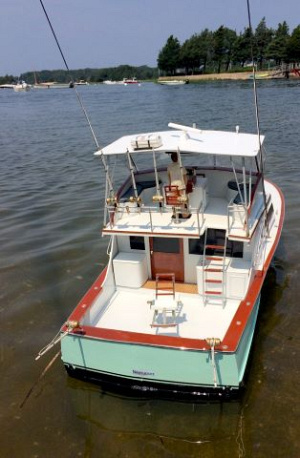
Awaiting graphics to finish off THUNDER& METEOR so pulled this one off the shelf to resume the build. I’ll start at the beginning posting highlights so as not to take up too much time.
Photo 1&2 One of the many real boats. These are iconic around Cape Cod, Martha’s Vineyard, Nantucket, & other Atlantic bordering states.
Photo 3 Starting the frame & keel.
[{"id":"175157882045","url":"https:\/\/model-boats.com\/media\/175157882045\/l","thumbUrl":"https:\/\/model-boats.com\/media\/175157882045\/s","name":"175157882045","caption":""},{"id":"175157886911","url":"https:\/\/model-boats.com\/media\/175157886911\/l","thumbUrl":"https:\/\/model-boats.com\/media\/175157886911\/s","name":"175157886911","caption":""},{"id":"175158003191","url":"https:\/\/model-boats.com\/media\/175158003191\/l","thumbUrl":"https:\/\/model-boats.com\/media\/175158003191\/s","name":"175158003191","caption":""}]
Awaiting graphics to finish off THUNDER& METEOR so pulled this one off the shelf to resume the build. I’ll start at the beginning posting highlights so as not to take up too much time.
Photo 1&2 One of the many real boats. These are iconic around Cape Cod, Martha’s Vineyard, Nantucket, & other Atlantic bordering states.
Photo 3 Starting the frame & keel.
Thanks Doug. It’s been an interesting build to this point. I started out to build a lobster boat hull to use as the basis to construct a lobster yacht. These conversions are not all that common but serve a noble purpose by restoring a no longer working lobster boat into a handsome yacht.
The sea-keeping characteristics of the lobster boat hull spawned an entire boat building industry in the U.S. Notable brands included Mackenzie, Fortier, Wasque, Brownell & others. Ranging from around 26 ft to 32 ft they were/are used for recreational fishing & day sailing.
Sorry for the long-winded response but the entire concept behind boats like the Wasque 26 has quite a history.
Bill
[{"id":"175159372841","url":"https:\/\/model-boats.com\/media\/175159372841\/l","thumbUrl":"https:\/\/model-boats.com\/media\/175159372841\/s","name":"175159372841","caption":""}]
Thanks Doug. It’s been an interesting build to this point. I started out to build a lobster boat hull to use as the basis to construct a lobster yacht. These conversions are not all that common but serve a noble purpose by restoring a no longer working lobster boat into a handsome yacht.
The sea-keeping characteristics of the lobster boat hull spawned an entire boat building industry in the U.S. Notable brands included Mackenzie, Fortier, Wasque, Brownell & others. Ranging from around 26 ft to 32 ft they were/are used for recreational fishing & day sailing.
Sorry for the long-winded response but the entire concept behind boats like the Wasque 26 has quite a history.
A condensed bit of history regarding the 26.
Not clear if the original design for the Wasque (“Wayskwee) 26 was from an established boat builder or a Jonesport, Maine lobster boat. Named after Wasque Point on the Vineyard the numerous shoals between there & Nantucket Island are a striped bass fishing haven. The boats were originally built in Vineyard Haven by Vineyard Yachts which closed in 1985.
Chris Hood, his Uncle Ted Hood was founder of Ted Hood Sails, found the original 26 mold in a field in 1995. Since then 45 Wasque 26s have been built. Today, Hood only builds the larger 32ft version.
C.W. Hood, including Chris, has very kindly provided me with invaluable information for my model. I am very grateful for their interest & assistance.
[{"id":"175164196727","url":"https:\/\/model-boats.com\/media\/175164196727\/l","thumbUrl":"https:\/\/model-boats.com\/media\/175164196727\/s","name":"175164196727","caption":""}]
A condensed bit of history regarding the 26.
Not clear if the original design for the Wasque (“Wayskwee) 26 was from an established boat builder or a Jonesport, Maine lobster boat. Named after Wasque Point on the Vineyard the numerous shoals between there & Nantucket Island are a striped bass fishing haven. The boats were originally built in Vineyard Haven by Vineyard Yachts which closed in 1985.
Chris Hood, his Uncle Ted Hood was founder of Ted Hood Sails, found the original 26 mold in a field in 1995. Since then 45 Wasque 26s have been built. Today, Hood only builds the larger 32ft version.
C.W. Hood, including Chris, has very kindly provided me with invaluable information for my model. I am very grateful for their interest & assistance.
I started this build with frames derived from an old kit, the Midwest Bass Boat. After C.W. Hood sent me a lines drawing of the 26 I realized frame 1 was much more narrow than the bass boat’s. That change plus adding another frame forward, not yet in place in photo 1, provided the much sharper entry of the 26. See photo 2.
[{"id":"175165180895","url":"https:\/\/model-boats.com\/media\/175165180895\/l","thumbUrl":"https:\/\/model-boats.com\/media\/175165180895\/s","name":"175165180895","caption":""},{"id":"175165153952","url":"https:\/\/model-boats.com\/media\/175165153952\/l","thumbUrl":"https:\/\/model-boats.com\/media\/175165153952\/s","name":"175165153952","caption":""}]
I started this build with frames derived from an old kit, the Midwest Bass Boat. After C.W. Hood sent me a lines drawing of the 26 I realized frame 1 was much more narrow than the bass boat’s. That change plus adding another frame forward, not yet in place in photo 1, provided the much sharper entry of the 26. See photo 2.
Time to begin sheathing with 1/16” plywood.
Photo 1 Inept is a good descriptor. In spite of the templating with cardboard that conformed nicely the plywood simply could not bend to the bow’s compound curves. So pieces, pieces, pieces. Unworkmanlike!!!
Photo 2 Portside a bit better with fewer pieces.
The takeaway is I need to get better at sheathing. Solutions include soaking plywood in window cleaner to increase flexibility or use 1/16” birch instead of ply.
Everything will work after using filler, two coats of flowable epoxy inside the hull, & lightweight glass cloth & epoxy applied on hull’s exterior.🤞
BTW, if brief history posts are not particularly interesting to folks I’ll refrain from similar posts in the future. Comments welcome.
[{"id":"175172170499","url":"https:\/\/model-boats.com\/media\/175172170499\/l","thumbUrl":"https:\/\/model-boats.com\/media\/175172170499\/s","name":"175172170499","caption":""},{"id":"175172173088","url":"https:\/\/model-boats.com\/media\/175172173088\/l","thumbUrl":"https:\/\/model-boats.com\/media\/175172173088\/s","name":"175172173088","caption":""}]
Time to begin sheathing with 1/16” plywood.
Photo 1 Inept is a good descriptor. In spite of the templating with cardboard that conformed nicely the plywood simply could not bend to the bow’s compound curves. So pieces, pieces, pieces. Unworkmanlike!!!
Photo 2 Portside a bit better with fewer pieces.
The takeaway is I need to get better at sheathing. Solutions include soaking plywood in window cleaner to increase flexibility or use 1/16” birch instead of ply.
Everything will work after using filler, two coats of flowable epoxy inside the hull, & lightweight glass cloth & epoxy applied on hull’s exterior.🤞
BTW, if brief history posts are not particularly interesting to folks I’ll refrain from similar posts in the future. Comments welcome.
I have used good grades of balsa wood and thin basswood on several of my projects. After filler, sanding, fibreglass cloth and polyurethane inside and out, the hulls have turned out fine.
Hi Chum444, the work you are doing with the hull is very original and interesting for me, but I don't understand how you do it.
There are many empty spaces to fill and you don't have enough water lines or frames to follow; for motorboats the free pieces are straight instead you curve them, from what I understand. But how do you do it? Do you adjust by eye? Can you still obtain symmetry?
You have great ability.
Good afternoon Alessandro. You are a good observer. There are only a few frames in this build. I created hull sheathing between frames by using plywood(inherently stronger than plain basswood or balsa sheet) & adding glass cloth & epoxy coat on hull exterior plus two coats of epoxy on the interior.
Regarding bending, the easy part is from the stern forward to the bow only requires a bend to form the rounded chine (curve between bottom & side of hull). The photo shows the longitudinal member (garboard strake) that runs the full length of the keel. Actually garboard strake is not the correct term. I’m uncertain what the proper name is. The sheathing is first glued here, bent to form the curve of the bilge & then glued to the longitudinal member (shear clamp) that again runs the length of the hull. That sheet is then finally glued to the frames. The sheer clamp has to be rounded on the bottom edge toward the keel to be able to form that curve.
The tricky part is forming the bow where the sheathing must bend in two directions. Learning how to do that for me was largely by doing it. All of the forward frame edges have to be tapered toward the curve to get the proper bend. I did add another frame forward of Frame1 to give me another attachment point in the compound curve.
There are several books available that discuss plank on frame building that you might find useful. Hope this helps.
[{"id":"175181437516","url":"https:\/\/model-boats.com\/media\/175181437516\/l","thumbUrl":"https:\/\/model-boats.com\/media\/175181437516\/s","name":"175181437516","caption":""}]
Good afternoon Alessandro. You are a good observer. There are only a few frames in this build. I created hull sheathing between frames by using plywood(inherently stronger than plain basswood or balsa sheet) & adding glass cloth & epoxy coat on hull exterior plus two coats of epoxy on the interior.
Regarding bending, the easy part is from the stern forward to the bow only requires a bend to form the rounded chine (curve between bottom & side of hull). The photo shows the longitudinal member (garboard strake) that runs the full length of the keel. Actually garboard strake is not the correct term. I’m uncertain what the proper name is. The sheathing is first glued here, bent to form the curve of the bilge & then glued to the longitudinal member (shear clamp) that again runs the length of the hull. That sheet is then finally glued to the frames. The sheer clamp has to be rounded on the bottom edge toward the keel to be able to form that curve.
The tricky part is forming the bow where the sheathing must bend in two directions. Learning how to do that for me was largely by doing it. All of the forward frame edges have to be tapered toward the curve to get the proper bend. I did add another frame forward of Frame1 to give me another attachment point in the compound curve.
There are several books available that discuss plank on frame building that you might find useful. Hope this helps.
Thank you so much for your explanation Chum444.
In fact what surprised me the most was the bow part.
I still think that to make a good curve (that is the same on starboard as on port) with so few handholds (or guides let's say) you need excellent manual skills and a good eye.
If it's so easy for you it's because you have excellent manual skills.
I saw this photo & thought an outboard version might be interesting. Plus I had a quite pristine Mercury outboard that needed a purpose. However I confirmed with C.W. Hood that they never offered that as an option. That combined with an experience I had with another build, looks cool, runs fairly well, but was in my mind very questionable in terms of the little outboard’s overall endurance eliminated that thought.
[{"id":"175181560698","url":"https:\/\/model-boats.com\/media\/175181560698\/l","thumbUrl":"https:\/\/model-boats.com\/media\/175181560698\/s","name":"175181560698","caption":""},{"id":"175181577992","url":"https:\/\/model-boats.com\/media\/175181577992\/l","thumbUrl":"https:\/\/model-boats.com\/media\/175181577992\/s","name":"175181577992","caption":""}]
I saw this photo & thought an outboard version might be interesting. Plus I had a quite pristine Mercury outboard that needed a purpose. However I confirmed with C.W. Hood that they never offered that as an option. That combined with an experience I had with another build, looks cool, runs fairly well, but was in my mind very questionable in terms of the little outboard’s overall endurance eliminated that thought.
I don’t disagree Alessandro. In the bow or other locations with compound curves the more frames the better. Before I begin the sheathing I check shape P & S with battens along many what would be waterlines on a lines drawing. Yes, there is a large “ pleasing to the eye” aspect to it. Can’t guarantee that P & S are 100% symmetrical but they can probably withstand all but a Naval Architect’s gaze. 😉
Having said all of this sheathing techniques are in many cases a product of preference & experience. By the way , I’ve never found a bare fiberglass hull I’ve purchased ( my usual starting point ) to be absolutely symmetrical.
I don’t disagree Alessandro. In the bow or other locations with compound curves the more frames the better. Before I begin the sheathing I check shape P & S with battens along many what would be waterlines on a lines drawing. Yes, there is a large “ pleasing to the eye” aspect to it. Can’t guarantee that P & S are 100% symmetrical but they can probably withstand all but a Naval Architect’s gaze. 😉
Having said all of this sheathing techniques are in many cases a product of preference & experience. By the way , I’ve never found a bare fiberglass hull I’ve purchased ( my usual starting point ) to be absolutely symmetrical.
Some prefer to use balsa blocks in the bow, and stern if its shape is complex, & sand it to shape. Glass cloth & resin then applied. Must work well as I’ve seen many use this technique in posts on a site in the U.S. Never tried it myself. Doubt I could come close to any symmetry that way.
After completing full knee replacement for right knee, I’ve regained enough mobility to proceed at some level with the 26.
Transitioned from cardboard to sintra for the foredeck. Rough fit looks good. I think I like the profile in photo 2 but will eyeball it a bit more. Since I used lines from another boat initially the length was of 1/12 scale. Turns out to be 1/14 scale so had to make the scale ruler in third photo.
After completing full knee replacement for right knee, I’ve regained enough mobility to proceed at some level with the 26.
Transitioned from cardboard to sintra for the foredeck. Rough fit looks good. I think I like the profile in photo 2 but will eyeball it a bit more. Since I used lines from another boat initially the length was of 1/12 scale. Turns out to be 1/14 scale so had to make the scale ruler in third photo.
Picking at the 26.
Constructed the gunnel framing.
Establishing the centerline for rough cutout of aft deck.
Looking at how cockpit sole, bulwarks, & covering boards will come together.
[{"id":"175373965533","url":"https:\/\/model-boats.com\/media\/175373965533\/l","thumbUrl":"https:\/\/model-boats.com\/media\/175373965533\/s","name":"175373965533","caption":""},{"id":"175373982214","url":"https:\/\/model-boats.com\/media\/175373982214\/l","thumbUrl":"https:\/\/model-boats.com\/media\/175373982214\/s","name":"175373982214","caption":""},{"id":"175373993769","url":"https:\/\/model-boats.com\/media\/175373993769\/l","thumbUrl":"https:\/\/model-boats.com\/media\/175373993769\/s","name":"175373993769","caption":""}]
Constructed the gunnel framing.
Establishing the centerline for rough cutout of aft deck.
Looking at how cockpit sole, bulwarks, & covering boards will come together.
Entire deck roughed out & dry fit. Motor has not found a home as yet. Unusual for my builds as I like to set the running gear early so I can get it in the test tank, look for leaks, & place the ballast. But since I can’t do a lot of steps to get to my power tools I’ve had to adapt.
Second difference for me with this build is the use of styrene for the topsides. I usually stick with basswood. Traditionalist or just a salty old guy? You tell me. Cutting with my super scissors made short work of a one piece cabin side.
[{"id":"175383632145","url":"https:\/\/model-boats.com\/media\/175383632145\/l","thumbUrl":"https:\/\/model-boats.com\/media\/175383632145\/s","name":"175383632145","caption":""},{"id":"175383636518","url":"https:\/\/model-boats.com\/media\/175383636518\/l","thumbUrl":"https:\/\/model-boats.com\/media\/175383636518\/s","name":"175383636518","caption":""}]
Entire deck roughed out & dry fit. Motor has not found a home as yet. Unusual for my builds as I like to set the running gear early so I can get it in the test tank, look for leaks, & place the ballast. But since I can’t do a lot of steps to get to my power tools I’ve had to adapt.
Second difference for me with this build is the use of styrene for the topsides. I usually stick with basswood. Traditionalist or just a salty old guy? You tell me. Cutting with my super scissors made short work of a one piece cabin side.
Gaining insight into running gear layout. The issue has always been how to install the shaft log with an oiling tube. Since the helm bulkhead & frame 2 are solid & that the log had to be longer than the space between them it couldn’t be installed from a forward position into the keel.Solution was to drill a centerline hole in both bulkheads. Then by moving the log through the #2 bulkhead toward the stem there is just enough room to slide the shaft log aft through the keel. It will be a short oiling tube but it will fit through the helm bulkhead ending up under the engine cover ( here, the clear box mock-up). At least that’s the plan.🤞
The rx will also be under the engine box. Servo to be determined.
[{"id":"175392050168","url":"https:\/\/model-boats.com\/media\/175392050168\/l","thumbUrl":"https:\/\/model-boats.com\/media\/175392050168\/s","name":"175392050168","caption":""}]
Gaining insight into running gear layout. The issue has always been how to install the shaft log with an oiling tube. Since the helm bulkhead & frame 2 are solid & that the log had to be longer than the space between them it couldn’t be installed from a forward position into the keel.Solution was to drill a centerline hole in both bulkheads. Then by moving the log through the #2 bulkhead toward the stem there is just enough room to slide the shaft log aft through the keel. It will be a short oiling tube but it will fit through the helm bulkhead ending up under the engine cover ( here, the clear box mock-up). At least that’s the plan.🤞
The rx will also be under the engine box. Servo to be determined.
Thank you Doug & Chris with the advice regarding how to eliminate a post made in error. I would have NEVER seen the trash bin to the left had you not pointed it out Chris. It certainly is dim at least on an iPad.
Okay, enough HOA talk over in the Forum. Working on the trunk cabin/cockpit coaming.
1 Balsa falseworks to hold things in shape &
two sides together.
2. I think the profile looks okay.
I’m working cabinets sides & gunnel width together to get the gunnels trimmed to the correct width sides set to a fair shape. Granted I’m using thin (0.040”) styrene but I find it very flimsy to work with other than for decking. We’ll see how rigid things become after I install all the bracing.
[{"id":"175415285474","url":"https:\/\/model-boats.com\/media\/175415285474\/l","thumbUrl":"https:\/\/model-boats.com\/media\/175415285474\/s","name":"175415285474","caption":""},{"id":"175415288430","url":"https:\/\/model-boats.com\/media\/175415288430\/l","thumbUrl":"https:\/\/model-boats.com\/media\/175415288430\/s","name":"175415288430","caption":""}]
Thank you Doug & Chris with the advice regarding how to eliminate a post made in error. I would have NEVER seen the trash bin to the left had you not pointed it out Chris. It certainly is dim at least on an iPad.
Okay, enough HOA talk over in the Forum. Working on the trunk cabin/cockpit coaming.
1 Balsa falseworks to hold things in shape &
two sides together.
2. I think the profile looks okay.
I’m working cabinets sides & gunnel width together to get the gunnels trimmed to the correct width sides set to a fair shape. Granted I’m using thin (0.040”) styrene but I find it very flimsy to work with other than for decking. We’ll see how rigid things become after I install all the bracing.
Installed & test ran the drive today.
1. A longer shaft log than I like but necessary.
2. Kept the motor mount screws loose, ran the
motor to let it do a final self alignment,
tightened the screws. Purrs like a kitten.
3. Lubrication tube location & fabrication worked
out as planned.
Shaft log is a common term ( at least in U.S.) used to describe the metal tube that supports the prop shaft. Doug & Thad sent me to the net to research its origin.
SHAFT LOG
A strengthening member fitted on the Keel, Keelson or Deadwood where the Stern tube passes through the hull. Originally a shaped
lump of timber, such logs may nowadays be made entirely of metal.
Not certain this really clarifies it. What is the stern tube? I assume it was a hole in the timber through which the prop shaft passed.
Shaft log is a common term ( at least in U.S.) used to describe the metal tube that supports the prop shaft. Doug & Thad sent me to the net to research its origin.
SHAFT LOG
A strengthening member fitted on the Keel, Keelson or Deadwood where the Stern tube passes through the hull. Originally a shaped
lump of timber, such logs may nowadays be made entirely of metal.
Not certain this really clarifies it. What is the stern tube? I assume it was a hole in the timber through which the prop shaft passed.
Well, the first time in the water not exactly a success. A serious leak immediately appeared at the point where the keel penetrates the hull. So, let the hull dry & added quite a bit more epoxy to where I thought I had already sealed.
Operation was a success; no leaks after the weighted hull sat in the water for almost two hours.
Then on to placement of ballast. Didn’t do a weight calculation just added lead fishing weights until things looked correct. 28 oz looks like it will suffice.
The test supervisor, who flew in from Baltimore nodded his approval.
[{"id":"175448881292","url":"https:\/\/model-boats.com\/media\/175448881292\/l","thumbUrl":"https:\/\/model-boats.com\/media\/175448881292\/s","name":"175448881292","caption":""},{"id":"175448894528","url":"https:\/\/model-boats.com\/media\/175448894528\/l","thumbUrl":"https:\/\/model-boats.com\/media\/175448894528\/s","name":"175448894528","caption":""},{"id":"175448856219","url":"https:\/\/model-boats.com\/media\/175448856219\/l","thumbUrl":"https:\/\/model-boats.com\/media\/175448856219\/s","name":"175448856219","caption":""}]
Well, the first time in the water not exactly a success. A serious leak immediately appeared at the point where the keel penetrates the hull. So, let the hull dry & added quite a bit more epoxy to where I thought I had already sealed.
Operation was a success; no leaks after the weighted hull sat in the water for almost two hours.
Then on to placement of ballast. Didn’t do a weight calculation just added lead fishing weights until things looked correct. 28 oz looks like it will suffice.
The test supervisor, who flew in from Baltimore nodded his approval.
Rudder post tack glued in place. Needs gussets or other strength members.
Rudder & skeg in place. Some tight clearances so weedy venues may be problematical.🤞
[{"id":"175486460110","url":"https:\/\/model-boats.com\/media\/175486460110\/l","thumbUrl":"https:\/\/model-boats.com\/media\/175486460110\/s","name":"175486460110","caption":""},{"id":"175486460580","url":"https:\/\/model-boats.com\/media\/175486460580\/l","thumbUrl":"https:\/\/model-boats.com\/media\/175486460580\/s","name":"175486460580","caption":""}]
Rudder post tack glued in place. Needs gussets or other strength members.
Rudder & skeg in place. Some tight clearances so weedy venues may be problematical.🤞
Since I don’t want to get kicked off the property that has my test pond I have to wait until the residents have mostly finished their use of the beach. That has gotten me out of sync with my usual build sequence.
I’ve been working toward cockpit templates for future construction. Photo shows a bit of how the finished cockpit will look. Cutting card stock much easier than wood or styrene. One thing becomes apparent; the engine cover box mock-up is oversized.
[{"id":"175564027350","url":"https:\/\/model-boats.com\/media\/175564027350\/l","thumbUrl":"https:\/\/model-boats.com\/media\/175564027350\/s","name":"175564027350","caption":""}]
Since I don’t want to get kicked off the property that has my test pond I have to wait until the residents have mostly finished their use of the beach. That has gotten me out of sync with my usual build sequence.
I’ve been working toward cockpit templates for future construction. Photo shows a bit of how the finished cockpit will look. Cutting card stock much easier than wood or styrene. One thing becomes apparent; the engine cover box mock-up is oversized.
The next gating item in my modified build sequence is the windscreen. Its exact size, shape, & location determines how I fabricate the trunk cabin roof. Specifically how much of it can be made removable to access the motor, ESC, the drive coupling. The more course mahogany grain renders it much less flexible than basswood for bending.
[{"id":"175624239750","url":"https:\/\/model-boats.com\/media\/175624239750\/l","thumbUrl":"https:\/\/model-boats.com\/media\/175624239750\/s","name":"175624239750","caption":""}]
The next gating item in my modified build sequence is the windscreen. Its exact size, shape, & location determines how I fabricate the trunk cabin roof. Specifically how much of it can be made removable to access the motor, ESC, the drive coupling. The more course mahogany grain renders it much less flexible than basswood for bending.
Phil,
Fortunately the pieces I am using are small in cross section so they can be bent (carefully) after a quick soaking in ammonia based window cleaner. The two side pieces are the main challenge.
The next issue is how to attach it to the hull so it is has some structural integrity to prevent it from being easily knocked off. The glazing will provide some rigidity but not to the degree that satisfies me. Haven’t thought this one through as yet.
So far a week’s work on the windscreen. Fiddly work with 18 individual pieces & more to come. Gaining on it!
[{"id":"175658746930","url":"https:\/\/model-boats.com\/media\/175658746930\/l","thumbUrl":"https:\/\/model-boats.com\/media\/175658746930\/s","name":"175658746930","caption":""},{"id":"175658754297","url":"https:\/\/model-boats.com\/media\/175658754297\/l","thumbUrl":"https:\/\/model-boats.com\/media\/175658754297\/s","name":"175658754297","caption":""}]
Finally can see the light at the end of the tunnel! So far, excluding the windows, the windscreen required 34 pieces to construct. Maybe one more sanding with 500 grit paper & one more coat of gloss clear. Then the windows & figuring out how to attach the screen to the hull in a way that is removable with the trunk cabin.
[{"id":"175710657673","url":"https:\/\/model-boats.com\/media\/175710657673\/l","thumbUrl":"https:\/\/model-boats.com\/media\/175710657673\/s","name":"175710657673","caption":""},{"id":"175710662253","url":"https:\/\/model-boats.com\/media\/175710662253\/l","thumbUrl":"https:\/\/model-boats.com\/media\/175710662253\/s","name":"175710662253","caption":""}]
Finally can see the light at the end of the tunnel! So far, excluding the windows, the windscreen required 34 pieces to construct. Maybe one more sanding with 500 grit paper & one more coat of gloss clear. Then the windows & figuring out how to attach the screen to the hull in a way that is removable with the trunk cabin.
Well, it’s been tack glue, marking fit pieces to fit, remove, cut, re-tack glue to check fit, & repeat! For next scratch build I need to improve cutting accuracy for bulkheads, gunnel support, etc. Same for applying epoxy sealer in hull interior. Kind of slopped epoxy blobs onto gluing surfaces. *#*”#!
Photos
Sprayed cockpit sides with ammonia based
window cleaner, clamped to gunnel, & left to sit
overnight. Will reduce tensile stress on joints
when finally glued in place.
Motor box fabricated. Servo will be hidden by
removable aft seat.
Owner is anxious for a boat ride but yard
schedule indicates that is in the distance.
[{"id":"175847189077","url":"https:\/\/model-boats.com\/media\/175847189077\/l","thumbUrl":"https:\/\/model-boats.com\/media\/175847189077\/s","name":"175847189077","caption":""},{"id":"175847200738","url":"https:\/\/model-boats.com\/media\/175847200738\/l","thumbUrl":"https:\/\/model-boats.com\/media\/175847200738\/s","name":"175847200738","caption":""},{"id":"175847210541","url":"https:\/\/model-boats.com\/media\/175847210541\/l","thumbUrl":"https:\/\/model-boats.com\/media\/175847210541\/s","name":"175847210541","caption":""}]
Well, it’s been tack glue, marking fit pieces to fit, remove, cut, re-tack glue to check fit, & repeat! For next scratch build I need to improve cutting accuracy for bulkheads, gunnel support, etc. Same for applying epoxy sealer in hull interior. Kind of slopped epoxy blobs onto gluing surfaces. #”#!
Photos
Sprayed cockpit sides with ammonia based
window cleaner, clamped to gunnel, & left to sit
overnight. Will reduce tensile stress on joints
when finally glued in place.
Motor box fabricated. Servo will be hidden by
removable aft seat.
Owner is anxious for a boat ride but yard
schedule indicates that is in the distance.
I’ve been making the cockpit sole, etc removable to provide access to running gear & bilge. This all because the 26’s bottom has not yet been wetted so I have no idea what might be amiss & require fixing or replacement
Spray rails glued & pinned to hull.
Decided on a bit of color change for deck.
Cockpit details begun; the fun stuff.
Owner anxious for first boat ride.
[{"id":"175957616026","url":"https:\/\/model-boats.com\/media\/175957616026\/l","thumbUrl":"https:\/\/model-boats.com\/media\/175957616026\/s","name":"175957616026","caption":""},{"id":"175957643598","url":"https:\/\/model-boats.com\/media\/175957643598\/l","thumbUrl":"https:\/\/model-boats.com\/media\/175957643598\/s","name":"175957643598","caption":""},{"id":"175957643741","url":"https:\/\/model-boats.com\/media\/175957643741\/l","thumbUrl":"https:\/\/model-boats.com\/media\/175957643741\/s","name":"175957643741","caption":""},{"id":"175957650383","url":"https:\/\/model-boats.com\/media\/175957650383\/l","thumbUrl":"https:\/\/model-boats.com\/media\/175957650383\/s","name":"175957650383","caption":""}]
I’ve been making the cockpit sole, etc removable to provide access to running gear & bilge. This all because the 26’s bottom has not yet been wetted so I have no idea what might be amiss & require fixing or replacement
Spray rails glued & pinned to hull.
Decided on a bit of color change for deck.
Cockpit details begun; the fun stuff.
Owner anxious for first boat ride.
That is coming along very nicely - I do like the windscreen shape that you have made.
I made something "similar" for the Chris Craft Corvette that I restored and I am thinking about making something like it for my Swordsman to replace the plain wrap-around screen too.
Thank you Bob. The windscreen proved to be quite a challenge given that it took over 30 pieces to construct. Should have constructed a fixture…..oh well!
On another note I hope your offset rudder solves your Kommander handling issue. Watching your video I see you were not running as fast as I had assumed. The wake also looked flat as it should. Tells me that prop walk(torque) is the issue assuming your prop is a right hand prop.
Hopefully I’m wrong but offsetting the rudder will reduce/solve the diving problem in right turns but will show up somewhere else. The reduced & asymmetrical water pressure on the
rudder may make left turns a problem. Left turn radius could become impossibly large & tracking straight may be difficult.
Anyway I’ll be watching to see how you make out.🤞
TOMLEON Dollhouse Dolls - Family Doll House People Set. 5 Poseable Action Figures Incl. Mom, Dad, Sister, Brother, Toddler. Compatible with All Dollhouses
The helm.
Looking aft at the cockpit
Motor box & stern seat.
Overall view of cockpit,
Clamshell vents for circulating air thru bilge.
Cabin porthole.
Cleat & fairleads on foredeck.
[{"id":"176360740779","url":"https:\/\/model-boats.com\/media\/176360740779\/l","thumbUrl":"https:\/\/model-boats.com\/media\/176360740779\/s","name":"176360740779","caption":""},{"id":"176360735031","url":"https:\/\/model-boats.com\/media\/176360735031\/l","thumbUrl":"https:\/\/model-boats.com\/media\/176360735031\/s","name":"176360735031","caption":""},{"id":"176360748333","url":"https:\/\/model-boats.com\/media\/176360748333\/l","thumbUrl":"https:\/\/model-boats.com\/media\/176360748333\/s","name":"176360748333","caption":""},{"id":"176360757231","url":"https:\/\/model-boats.com\/media\/176360757231\/l","thumbUrl":"https:\/\/model-boats.com\/media\/176360757231\/s","name":"176360757231","caption":""},{"id":"176360770392","url":"https:\/\/model-boats.com\/media\/176360770392\/l","thumbUrl":"https:\/\/model-boats.com\/media\/176360770392\/s","name":"176360770392","caption":""},{"id":"176360785025","url":"https:\/\/model-boats.com\/media\/176360785025\/l","thumbUrl":"https:\/\/model-boats.com\/media\/176360785025\/s","name":"176360785025","caption":""},{"id":"176360784835","url":"https:\/\/model-boats.com\/media\/176360784835\/l","thumbUrl":"https:\/\/model-boats.com\/media\/176360784835\/s","name":"176360784835","caption":""}]
The helm.
Looking aft at the cockpit
Motor box & stern seat.
Overall view of cockpit,
Clamshell vents for circulating air thru bilge.
Cabin porthole.
Cleat & fairleads on foredeck.
Most of final details completed prior to shipping boat to Florida for maiden voyage.🤞🤞🤞
Then finish up punch list.
[{"id":"176566379961","url":"https:\/\/model-boats.com\/media\/176566379961\/l","thumbUrl":"https:\/\/model-boats.com\/media\/176566379961\/s","name":"176566379961","caption":""},{"id":"176566380578","url":"https:\/\/model-boats.com\/media\/176566380578\/l","thumbUrl":"https:\/\/model-boats.com\/media\/176566380578\/s","name":"176566380578","caption":""},{"id":"176566395348","url":"https:\/\/model-boats.com\/media\/176566395348\/l","thumbUrl":"https:\/\/model-boats.com\/media\/176566395348\/s","name":"176566395348","caption":""},{"id":"176566395617","url":"https:\/\/model-boats.com\/media\/176566395617\/l","thumbUrl":"https:\/\/model-boats.com\/media\/176566395617\/s","name":"176566395617","caption":""}]
Thank you Phil. The boat will go to Florida with the builder who escapes the New England winters for three months. In the past my wife & I enjoyed the snow & winter sports but age caught up with us so skiing is no longer an option.
As mentioned earlier in this thread I usually do the maiden voyage early in the build. But rehabbing from knee surgery prevented that. So I will use the large test tank ( the condo association’s pool) for the first splash. Thus the crossed fingers.
Warm enough to send the Lindsay M on her maiden voyage.
- I thought it would be too slow…it was.
- Limited rudder throw looked like turning radius
would be excessive…it wasn’t
- No leaks expected…none showed up.
[{"id":"177076065597","url":"https:\/\/model-boats.com\/media\/177076065597\/l","thumbUrl":"https:\/\/model-boats.com\/media\/177076065597\/s","name":"177076065597","caption":""},{"id":"177076040756","url":"https:\/\/model-boats.com\/media\/177076040756\/l","thumbUrl":"https:\/\/model-boats.com\/media\/177076040756\/s","name":"177076040756","caption":""}]
Warm enough to send the Lindsay M on her maiden voyage.
- I thought it would be too slow…it was.
- Limited rudder throw looked like turning radius
would be excessive…it wasn’t
- No leaks expected…none showed up.
After making a somewhat major ballast redistribution LindsayM floats as intended. I polished the shaft to reduce friction with the shaft log which greatly reduced the running amperage & the resulting motor heat. Still more to be done to cleanup the shaft log & change to a three blade prop. Those mods have to wait until I’m home. But for now it’s running much better.
[{"id":"177426915711","url":"https:\/\/model-boats.com\/media\/177426915711\/l","thumbUrl":"https:\/\/model-boats.com\/media\/177426915711\/s","name":"177426915711","caption":""}]
After making a somewhat major ballast redistribution LindsayM floats as intended. I polished the shaft to reduce friction with the shaft log which greatly reduced the running amperage & the resulting motor heat. Still more to be done to cleanup the shaft log & change to a three blade prop. Those mods have to wait until I’m home. But for now it’s running much better.
Both the Wasque 26 & the Northern Bay 36 sport fisherman survived the transit without damage.First yard work order was to repower the too-slow original motor with a higher RPM motor of the same 380 size. High confidence the high end performance will be satisfactory.
Sea trial date to be determined.
Out with the old.
In with the new.
[{"id":"177776044093","url":"https:\/\/model-boats.com\/media\/177776044093\/l","thumbUrl":"https:\/\/model-boats.com\/media\/177776044093\/s","name":"177776044093","caption":""},{"id":"177776044369","url":"https:\/\/model-boats.com\/media\/177776044369\/l","thumbUrl":"https:\/\/model-boats.com\/media\/177776044369\/s","name":"177776044369","caption":""}]
Returned to the north branch of the Cape Cod & Southwest Florida Shipyard
Both the Wasque 26 & the Northern Bay 36 sport fisherman survived the transit without damage.First yard work order was to repower the too-slow original motor with a higher RPM motor of the same 380 size. High confidence the high end performance will be satisfactory.
Sea trial date to be determined.
Philuk👍
👍👍👍