
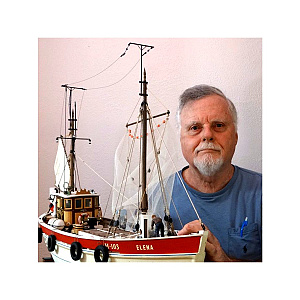
I thought I would put together a video on this title. It follows the concept of making something travel a linear distance with limit stops on both ends. The belt and pulleys are from an old HP inkjet printer. (Lots of usable parts in these discarded printers.) This Springer is based on a real boat using four photographs. Enjoy!
Lew
Florida, USA
https://youtu.be/ny1ukVCP4Gc?si=VifrtoZ9wqx6hixZ
I thought I would put together a video on this title. It follows the concept of making something travel a linear distance with limit stops on both ends. The belt and pulleys are from an old HP inkjet printer. (Lots of usable parts in these discarded printers.) This Springer is based on a real boat using four photographs. Enjoy!
Lew
Florida, USA
Chum444,
There are only two ways water can enter through the deck, and both are hatches.
The aft hatch is close fitting, and flange around the bottom of the opening.
The hatch under the structure has a little extension the deck plate that snuggly fits into the deck.
Water does get on the deck, especially when going fast. Sometimes it does sleep in so when I am done I use a "turkey baster" or syringe to remove what I can and leave the hatches open until the next meet.
Lew
Florida, USA
[{"id":"169595889171","name":"169595889171","caption":"","url":"https:\/\/model-boats.com\/media\/169595889171\/l","thumbUrl":"https:\/\/model-boats.com\/media\/169595889171\/s","isImage":false,"ext":"file"}]
There are only two ways water can enter through the deck, and both are hatches.
The aft hatch is close fitting, and flange around the bottom of the opening.
The hatch under the structure has a little extension the deck plate that snuggly fits into the deck.
Water does get on the deck, especially when going fast. Sometimes it does sleep in so when I am done I use a "turkey baster" or syringe to remove what I can and leave the hatches open until the next meet.
A very clean installation. I will certainly keep this in mind.
Barry