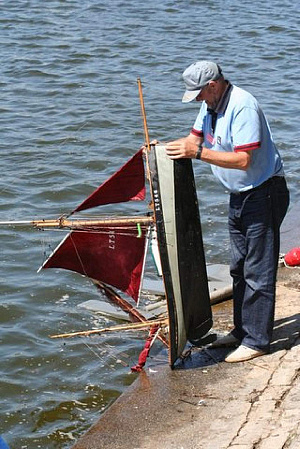
Duke of Devonshire.

Started by hammer

40 updates 7 likes 31 comments

The Question

Is any one looking? Should this be called the fire boat site. 😯 🔨 I do have a 36" in a sorry state. last run 1952 with a FROG 1.5cc .
4 comments
  1. Flack
    Warrant Officer
    Like Alan I have followed every one of your blog updates and found them to be a real insight into the art of scratch building. I think some of the lengths you have gone to in order to produce all the little bits and pieces that go together to make one part of your model is a credit to your skill and patience - the paddle wheel is a prime example 👍
  2. hammer
    Lieutenant
    Well now I know. Sorry I was a bit cheeky, I could see no other way of finding out. I do like Fire boats honest. in fact all models. I do hope someone will benefit from the post, & see paddle wheels are not that difficult to make.

Sign in to comment on this update.

Back to the hull

The cruiser stern a carved from the solid, hollowed out to clear the rudder control arm. The deck laid with strips of 1.5mm ply, the edges blackened with marking pen. A cover board will be laid around the scuppers, after the bulwarks are fitted. The bulwarks of 1.5mm ply glued in a rebate 3/8" below deck level. I use a polyurethane for this, strong waterproof and gap filling. I forgot to say with this glue I do not chamfer the frames to the line of the hull (just leave them square), Saves a lot of time, & I have had no trouble. The fore deck easy enough, luckily on this ship a samson post allowed a joint just at the start of the tight turn. Not only tight but far from vertical.

Sign in to comment on this update.

bulwarks

Laminated two layers of 1mm ply around the stern. Around the sponsons I used plasticard I don't normally Like it but got it cheep. I had no evidence of a grating over the rudder but it was normal practice.

Sign in to comment on this update.

plating

After laying glass mat in the engine room. I gave the outside of the hull a coat of resin. I have collected aluminium drink cans, not all mine, only the cider cans. This is the plating, Following the lines on the hull the inner lines of plates are stuck on using Impact adhesive. When laying the outer lines very carefully cut out to size, place in position stick tape to one edge. Lift back and spread the glue, four or more can be done at once, folding down and tap with small hammer. finally run super glue along the edges.
3 comments
  1. AlanP
    Lieutenant
    Look forward to seeing the finished hull after plating, are you going to use an etching primer on the aluminium plating before a top coat?

    Alan
  2. hammer
    Lieutenant
    Nice to receive a bit of flack, the good kind for a change. 😁 The process doesn't take that long as many as six plates can be done at the same time. 🔨
    Alan No etching primer, that's why the painted side of the cans are outside. if you look at the paddle wheels the etching can be seen on these. Ex stock car wing, from my racing days.
    Thanks for your comments. 👋

Sign in to comment on this update.

more plating

I forgot to say with this method rivets can be shown by punching from the back first. But on this type of boat counter sunk rivets would have been used. I did indulge and show some in the rudder.
The stern was the only problem beating thin material around the compound curve was tricky.
To re leave any boredom when a repetitive job is being done, I will do something else in between. it this case made the funnel, more cans rapped around a former. (curtain pole) The join behind the steam pipes,

Sign in to comment on this update.

Onward & upward

The superstructure another layer of plasticard on the sponsons. Two because I only had narrow strips. This includes the paddle box. in the background can be seen the information wall, with the elevation ,body plan & some of the photos. The base of the funnel cut from empty solvent can. The ventilators a table tennis ball cut in half & stuck on alI tube.

Sign in to comment on this update.

Preparing plates

To flatten the cans, after cutting off the top& bottom slit up through. Place on a cloth next to the edge of worktop, rounding side up & rub with a length of pipe. Keeping hand away from sharp edges.

Sign in to comment on this update.

joinery

The deck houses mahogany vernier on balsa. My mantra build as light as possible, weight can always be added, difficult to take off. The frame of balsa has a strip of plastic ( cut from lemonade bottle) for the glass. Then layers of vernier glued over to form the panels. The stairs done with the same method. The steps are removable to give access to the gas burners.

Sign in to comment on this update.

proud of this

This boat was old fashioned even for 1896, having the bridge behind the funnel & a walkway forward around the funnel. Here again I took an educated guess, decided to do it in grating, as on SS Great Britain. Gave myself a problem. 😰 How ever I am very proud of the outcome. Took a piece of 1/2" ply and turned away unwanted wood, leaving a ring to fit around the funnel, and one for the outside of the walkway. Also left a step for the grating to rest on. Then filled in the gratings. I did buy the grating kit from Modeltimbers. That caused me pain, 😭 as if you are following this you will know by now, I don't spend if I can avoid it. Cutting of the waste a bit of sandpaper, job done.
3 comments
  1. hammer
    Lieutenant
    I must not be to down hearted. I was running out, but to avoid buying another pack. I found coffee string sticks on edge a perfect fit in the notches, cut them down and fitted every other one in the top layer. No need to notch them. 😁

Sign in to comment on this update.

life boats

Flack posted I must have had patience plating the hull, well nothing compared to planking the deck. 😯 So to brake the monotony made the life boats in between. Made on the same principle as full size. Keel, stem, rudder post & 2 formers. in M.B. magazine there was an article where a clinker boat was shown made with straight planks, not right at all. The only straight planks are the first & last. The 2 planks shown are only the second up, at the bilge an even greater curve required. The white peg is holding a straight plank ready to mark off the previous. it could be forced up to fit but will not lay unstressed.
1 comment
  1. Flack
    Warrant Officer
    Making the planked lifeboats - including the lifelines and a cover is a build in itself. 👍

Sign in to comment on this update.

Delete this post?

It will be removed from the site.

Discard this draft?

Your draft will be deleted and cannot be recovered.

You have an unfinished draft

What would you like to do with it?