Duke of Devonshire.

Started by hammer

40 updates 7 likes 31 comments

lifeboats 2

The life lines, roll the string around a metal former (pipe) coat with weak p.v.a. When dry cut off the loops glued to the boat individually. The top of the former is replaced to attach the falls & hold up the cover. The cover is cooking foil coated with thick p.v.a. both before & after fixing. What good is a lifeboat if it sinks, we past the test.
1 comment
  1. AlanP
    Lieutenant
    Very nice hammer, perhaps you could do a detailed build thread on making one of these, when you have time.
    No pressure 😁

    Alan

Sign in to comment on this update.

Clinker boats

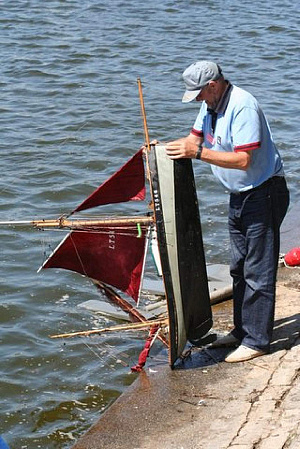
A build blog on clinker boats, if I can find the time I will. No photos other than shown, so would have to build one. Just to wet your appetite as they say on Blue Peter. Here is one I made earlier. This one 3/4"= 1' for a Bristol Channel pilot cutter. Only one oar as they always sculled. So might be a long wait. Alan.
Flack. the lifeboats just quickies.
1 comment
  1. AlanP
    Lieutenant
    Will look forward to that, I don't need one for a boat, I would just like to be able to build one. 😀

    Alan

Sign in to comment on this update.

and another

This was my first attempt, built for sailing trawler. Note the hurricane lamp, a torch bulb stuck in a nylock nut, wire handle with a small nut on the top. 🤒

Sign in to comment on this update.

Back to the duke

Saved a wooden chair from the scrap heap, knew it would come in handy. Nice beech just right for the hand rails. The grain could be cut to follow the curves & enough straight as well. After cutting out a groove 1/8" deep in the bottom to fit over the bulwarks. Job done.
1 comment

Sign in to comment on this update.

handrails

A close up of the rail, at the bulwark door. Open and shut on home made hinges. Also pictured the angle Iron supports for the bulwarks. Bent up from zink sheet, with the rivets punched in. When I need to lines of rivets, I put a row or three of self punching panel pins ( they have pointed heads) in a block of wood, leaving 1/4" projecting. Place on the back of the plate and tap with hammer. I have never had success with clock wheels, skid all-over the place. if anyone wan't to see how I make 1/4" square hinges ask.
Liked by mehmetalialtas
1 comment

Sign in to comment on this update.

steps

Steps to the bridge. Mark out and cut the strings, the slots for the treads cut with a razor saw. Two cuts per step at the second cut force the saw away from the first and the waste will pop out. After preparing the treads glue in the end two. When these are set slide in the remainder. 😯 The main passenger stair is of different construction the treads fixed to cleats, not let in to the strings. The assembly procedure is the same.

Sign in to comment on this update.

railings

I purchased the stanchions, they are made like split-pins. I used copper wire striped from electrical cable for the rails, a little soft but cheep. Bending the rails to shape on the deck. The first assembly ( as photo) not at all good. So I made small rings glued to the stanchions after threading on the rails. Fixed at the correct hight solved the problem of the wavy rails. They also simulate base plates.
3 comments
  1. hammer
    Lieutenant
    Yes Alan they do, when you think you have them right take a photo and see the mistakes. 😯
  2. hammer
    Lieutenant
    Sorry forgot, the stanchions, I obtained them from.
    James Lane (display models)
    30 Broadway
    BLYTH
    Northumberland
    NE24 2PP
    I don't know if he is still working as I got them some time ago. But at the time 3 first class stamps & a self addressed envelope would secure his catalogue.

Sign in to comment on this update.

Bridge furniture.

The helm on paddlers normally in brass. Turned the rim & boss on the end of 1.25" brass rod, with a hole in the centre. Marked the position of the spokes on the lathe, no drill on the tool post. So drilled for the 1.5mm spokes very carefully. Glued the spokes in with epoxy. Back in the lathe to part off the rod, then bolt through the centre hole, back in the lathe to clean up the back, trim the handles.
The telegraph stem two different sizes of brass tube, the dial 1/2" tube filled with balsa and printed (on computer) paper stuck on both sides. All in place including the binnacle, the Iron balls are mapping pins the compass printed paper again. The finished rails seen with the dodgers, made from cooking foil covered with PVA glue & painted. The speaking tube just bent & flared out on the end.

Liked by mehmetalialtas and hammer
2 comments
  1. AlanP
    Lieutenant
    Some very nice detail there Robert, looks really nice on the boat 👍

    Alan

Sign in to comment on this update.

lights

Lights, not that I will ever sail in the dark. 😀 The search light forward of the funnel on the walkway. The bulb a 12 volt halogen, works on 6v fine. The lamp a container with a clear lid. The wife had something in it can't remember what. The wire pass through the walkway support.

Sign in to comment on this update.

Light, navigation

Again won't be sailing in the dark, but they do work. I was given some LED's I think 💭 came out of computers? Striped the plastic holder, then stuck them in the brass lamps with clear bath silicone. Having painted the port & starboard red & green. Hexagon brass rod turned off centre. ( packed one jaw of the three jaw chuck). Milled a flat on the curved side. After parting off drilled up through to bottom.
Liked by mehmetalialtas
2 comments
  1. AlanP
    Lieutenant
    When you have finished this build, perhaps you could do a thread on How to use a lathe. 😊

    Alan
  2. hammer
    Lieutenant
    I am no expert on the lathe Alan, sorry totally self taught. I maybe doing it all the wrong way.

Sign in to comment on this update.

Delete this post?

It will be removed from the site.

Discard this draft?

Your draft will be deleted and cannot be recovered.

You have an unfinished draft

What would you like to do with it?